I think it would be awesome to make sculptural work.
I spent much of my childhood not actually playing with toys but posing them. G.I. Joes, plastic cars, Barbies, tissue boxes, anything I could get my hands on would end up displayed in gigantic battles and slice-of-life comedies on my bedroom desk. I'd always leave them posed that way for a couple days since the work to get them upright and undisturbed took hours, but after that I'd disassemble them and making something new. Funnily, I've never stopped thinking of my work in terms of a 3d playset despite working on two-dimensional surfaces; my priority is still to pose the characters in ways that communicate their relationships to each other and also tell a story while showing off a fabricated location.
So for sculptural work, either I could go the toy route and make little fantasy-themed dioramas filled with movable characters, or I could do the same thing in life-size, with viewers able to walk through the setting with its individual sculptures (characters caught up in the overarching narrative of the scene, interacting with each other and their surroundings). The sculptures would be colorful and cartoony, with stylized painted backgrounds and props.
As one example of the type of stuff I'd do, I could fabricate a hole in a gallery wall that would have an enormous eye peeking into a brightly colored living room with plaster painted furniture. Freestanding characters would be recoiling in fear, dropping household items and bolting towards the exit. I'd like viewers to walk through and examine little details of the setup while just appreciating the humor of the narrative and being a part of its space. In a sense, working in 3d would more easily fulfill my goal of engaging viewers in the entertaining aspects of artwork.
Sunday, October 11, 2015

Sunday, October 4, 2015
Yoshitomo Nara is a Japanese pop artist who delves into painting, woodcuts, and three-dimensional art. Most of his works feature small female children with deceptively cute features that belie their mature facial expressions or accessories (which include knives and cigarettes). The cute-creepy hybrid of his characters is part of a "kimo kawaii" (literally, "disgusting cute") subset of Japanese culture, different from the more typical "kawaii" ("cute") popularized by icons like Hello Kitty.
Nara grew up a fairly independent child since his working class parents were often away from home, and his art seem to convey his feelings about that situation. The works are fantastical, imaginative, cartoony, and seem to resist the realities of growing up and facing the world.
I'm not usually satisfied by artworks that are simple, plain, and flat, because I myself aspire to move beyond that type of work. Having said that, the aesthetic is more or less ingrained in me. Nara's characters have an intriguing presence and I enjoy that their lack of detail brings my gaze to their eyes. And I'm not above admitting that some of them are very cute.
But the popular opinion of these girls' appeal is really their punk, independent spirit. The children seem confident, wise, experienced, defiant, indignant, emotionally fortified and strong-willed. To me, corrupted is another adjective that comes to mind. With their pop art stylization, the girls can be seen as icons of lost innocence, or perhaps as protectors of innocence who have already lost the battle themselves. Speaking of his works where the children hold weapons, Nara says “I kind of see the children among other, bigger, bad people all around them, who are holding bigger knives..." And with the children often looking up at the viewer, we seem to be implicated as part of the problem.
Some of Nara's works are designed like pages taken from a child's journal, and these cutesy scribbles combined with his more maturely composed portrait subjects seem to document a shift from innocence to maturity. The indirect implication of this shift makes the images all the more unsettling, like a horror-themed puzzle missing the piece that details the face of its monster; we don't know what happened to make these children look at us the way they do.
 |
| Too Young to Die, 2001 |
 |
| I Don't Want to Grow Up, 2001 |
 |
| Cosmic Girl (Eyes Open, Eyes Shut), 2008 |
But the popular opinion of these girls' appeal is really their punk, independent spirit. The children seem confident, wise, experienced, defiant, indignant, emotionally fortified and strong-willed. To me, corrupted is another adjective that comes to mind. With their pop art stylization, the girls can be seen as icons of lost innocence, or perhaps as protectors of innocence who have already lost the battle themselves. Speaking of his works where the children hold weapons, Nara says “I kind of see the children among other, bigger, bad people all around them, who are holding bigger knives..." And with the children often looking up at the viewer, we seem to be implicated as part of the problem.
Some of Nara's works are designed like pages taken from a child's journal, and these cutesy scribbles combined with his more maturely composed portrait subjects seem to document a shift from innocence to maturity. The indirect implication of this shift makes the images all the more unsettling, like a horror-themed puzzle missing the piece that details the face of its monster; we don't know what happened to make these children look at us the way they do.
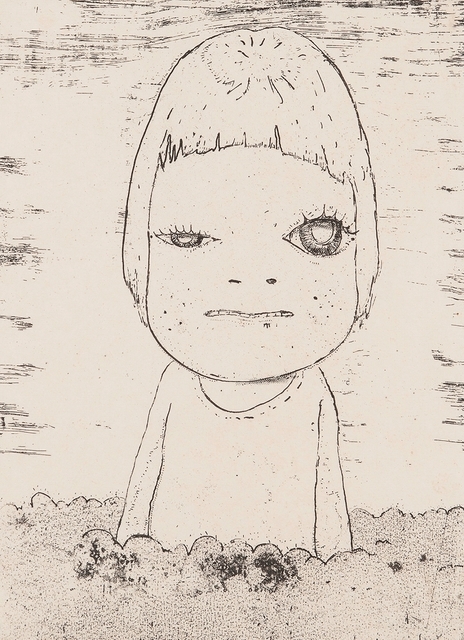 |
| Haze Day, 2002 |
Adrian Ghenie is a Romanian painter whose work suggests the aftermath of ideological struggles, war, and dictatorship, with allusions to the history of Romania and Europe in general. He takes heavy inspiration from cinema and art history.
World War II is of particular interest to Ghenie. “No discovery is ever good or bad—it depends on how you use it,” he muses on Darwin's theory of natural selection, which inspired Nazi eugenics. He sees the melding of malicious ideologies with bureaucratic objectives as a failure that could happen to any person, but especially to those with a lust for power. We don't see this concept fleshed out in narrative painting formats but rather in emotive still-shots that seem to capture figures at the heights of insanity. I'm fond of the universality of his ideas despite the lack of storytelling.
 |
| The Sunflowers in 1937, 2014 |
"Film has provided the most important ingredient of my visual background," Ghenie explains. "When I paint I have the impression that I am also involved in directing a film... I think consciously and unconsciously I want to master in painting what David Lynch has done in cinema." Beyond Lynch's surreal dramas, the artist also references 1920s silent comedies in his "Pie Fight" series, which corrupts iconic imagery of comedic food fights with bloody smears and fragmented Nazi imagery.
 |
| Pie Fight Study 18/2/12, 2012 |
 |
Pie Fight Interior 8, 2012 |
Like other artists I've examined on my blog, Ghenie has an impressionist style, and his paintings are very weathered, sculptural, and look like messy palette studies with how paint is haphazardly smeared across them. I enjoy them for their messy patterns, with colorful shapes breaking up the more flat but realistic planes.
Ghenie does appropriate from other artists and his work has often been compared to Francis Bacon's, but I don't feel he reaches the same type of angst that Bacon's work does. Ghenie's work is more colorfully varied and explosive, and leans towards violence more than the quiet, weird, foreboding malice of Bacon's figures. He is also far more cinematic in his compositions, which don't feel idealized and meticulously planned but rather like cropped play-sets. When Ghenie does do subtle, he also paints with much greater realism. I'm a fan of both his styles.
 |
| Dada is Dead, 2009 |
Subscribe to:
Posts (Atom)